Fluffy Buttermilk Pancakes from Scratch
There is a specific kind of pancake disappointment where they look right, they smell right, and then you cut in and find something closer to a savory crepe than a stack of pillows. I made those pancakes for years. They were edible. Nobody asked for seconds.
Two things changed it, and neither of them is an ingredient. The first is stopping the mixing far earlier than feels correct. The second is letting the batter sit for five minutes before a single pancake hits the pan. That is the entire secret, and it costs nothing.
The One Thing That Matters Most
A lumpy batter makes a fluffy pancake. A smooth batter makes a flat one. This feels backwards, which is exactly why so many people get it wrong.
When flour meets liquid, gluten starts forming, and the more you stir, the more of it you build. Gluten makes bread chewy and structured, which is wonderful in bread and terrible in a pancake — it tightens the batter so the bubbles created by the baking powder cannot expand freely. The result is dense and slightly rubbery. So you stir until the dry flour has just disappeared, and you accept a batter that looks unfinished. Those lumps hydrate on their own during the rest.
The rest does two jobs at once. It gives the flour time to absorb the buttermilk, which thickens the batter naturally without more mixing, and it gives the baking soda time to start reacting with the acid in the buttermilk. By the time the batter hits the griddle it is already full of small bubbles that the heat then expands. Five minutes is enough. Much more than fifteen and you start losing lift.
The buttermilk itself is doing real work here, not just adding tang. It is acidic, and that acid is what activates the baking soda — the soda alone does nothing without something sour to react with. It also tenderizes the gluten that does form, which is a second line of defense against toughness.
Ingredient Notes
- All-purpose flour (2 cups). Spoon it into the measuring cup and level it off rather than scooping. Scooping compacts the flour and can add nearly a quarter more than the recipe intends, which is one of the most common causes of heavy pancakes.
- Baking powder (2 tsp) and baking soda (1/2 tsp). Both, not one or the other. The soda reacts with the buttermilk for immediate lift and helps with browning; the powder provides a second rise triggered by the heat of the pan. Check that your baking powder is still alive — drop half a teaspoon into hot water and it should fizz enthusiastically.
- Buttermilk (2 cups). Real buttermilk is worth buying. If you do not have it, stir 2 tablespoons of white vinegar or lemon juice into 2 cups of regular milk and let it sit for 10 minutes. It is not identical — real buttermilk is thicker and gives a better crumb — but it works.
- Eggs (2 large). Room temperature blends more evenly into the batter. Cold eggs can seize the melted butter into little solid specks.
- Melted butter (3 tbsp). Let it cool for a minute before whisking it into the cold buttermilk, for the same reason.
- Sugar (2 tbsp). Modest on purpose. Enough to help the surface brown and to round out the tang of the buttermilk, not enough to make the pancakes taste sweet on their own.
How to Make Them
Whisk the dry ingredients together thoroughly first. Flour, sugar, baking powder, baking soda, salt. This is the one stage where you can mix as much as you like, and doing it properly means the leavening is evenly distributed — otherwise you get pockets that taste metallic.
Whisk the wet ingredients separately. Buttermilk, eggs, melted butter, vanilla, until uniform.
Combine gently and stop early. Pour the wet into the dry and fold with a spatula about ten to twelve strokes. Stop when there is no dry flour visible, even though the batter is still visibly lumpy. Resist the urge to smooth it out.
Rest 5 minutes. The batter will thicken and you may see bubbles rising to the surface. That is the reaction you want.
Heat the griddle over medium — and get this right. Too hot is the second most common mistake after over-mixing. A drop of water should sizzle and skate across the surface, not vanish instantly with a crack. If the pan is too hot the outside browns in ninety seconds while the middle is still batter. Medium, and give the pan a full three or four minutes to come to an even temperature.
Pour about 1/4 cup per pancake and leave room between them. Do not press them down with the spatula, ever. Pressing collapses the structure you spent all this effort building.
Flip when the bubbles that form on the surface start popping and staying open, and the edges look dry and set — roughly 2 minutes. If you flip when the bubbles are still sealing over, the pancake is not ready and will deflate. One flip only. The second side takes 1–2 minutes.
Keep finished pancakes warm in a 200°F oven on a wire rack, not stacked on a plate. Stacking traps steam and the bottoms go soggy.
Troubleshooting
- Flat and dense. Over-mixed, expired baking powder, or too much flour from scooping.
- Raw in the middle, dark outside. Pan too hot. Lower the heat and wait for it to settle before the next batch.
- Pale and blotchy. Pan not hot enough, or too much butter greasing the surface. A thin film is all you need — wipe the excess with a paper towel.
- Uneven, lopsided shapes. Batter poured from too high. Pour from just above the surface and let it spread on its own.
- Slightly bitter or soapy taste. Too much baking soda, or it was not evenly whisked into the flour.
Variations
- Blueberry. Do not stir berries into the batter — they bleed and weigh it down. Pour the pancake first, then drop the berries on top before flipping.
- Chocolate chip. Same method as the blueberries. Mini chips distribute better than standard ones.
- Cinnamon. 1 teaspoon whisked in with the dry ingredients.
- Lemon poppyseed. The zest of one lemon plus 1 tablespoon of poppyseeds. Add the zest to the sugar and rub it in with your fingers first to release the oils.
- Whole wheat. Replace up to half the flour with white whole wheat. Going further makes them noticeably heavy.
Make Ahead and Storage
Cooked pancakes keep in the refrigerator for up to 3 days in an airtight container. They reheat well in a toaster, which is much better than a microwave — the toaster crisps the outside again while the microwave leaves them limp.
They freeze beautifully. Cool them completely, then freeze in a single layer on a tray before bagging them so they do not fuse together. Straight from frozen, a pancake takes about 90 seconds in the toaster. This is genuinely worth doing on a Sunday; a stack of homemade pancakes in the freezer is better than any boxed frozen version.
The batter is the one thing that does not keep. Once the leavening has reacted, it is on a clock, and batter made the night before produces flat pancakes in the morning. What you can do instead is whisk the dry ingredients together and leave them in a bowl overnight, so the morning job is only the wet ingredients and a quick fold.
Questions People Ask
Can I make the batter the night before?
No — the baking soda reacts with the buttermilk immediately and will be spent by morning. Pre-measure the dry mix instead and combine in the morning.
What if I don’t have buttermilk?
Add 2 tablespoons of lemon juice or white vinegar to 2 cups of milk and let it stand 10 minutes. Plain yogurt thinned with milk to a pourable consistency also works well.
Why do my pancakes deflate after I flip them?
Usually flipping too early, or pressing them with the spatula. Wait until the surface bubbles are popping and staying open, then flip once and leave them alone.
Can I double this recipe?
Yes, it scales cleanly. Just be aware that the batter for the last pancakes will have been sitting longer, so those will be slightly less lofty. Mix a second half-batch partway through if you are feeding a crowd.
How do I keep pancakes warm without ruining them?
A wire rack in a 200°F oven, in a single layer. Stacking them on a plate steams the bottoms soft.
Can I use this batter for waffles?
Not as written — waffles need more fat and sugar to crisp properly. Increase the melted butter to 6 tablespoons and the sugar to 1/4 cup and it will work.
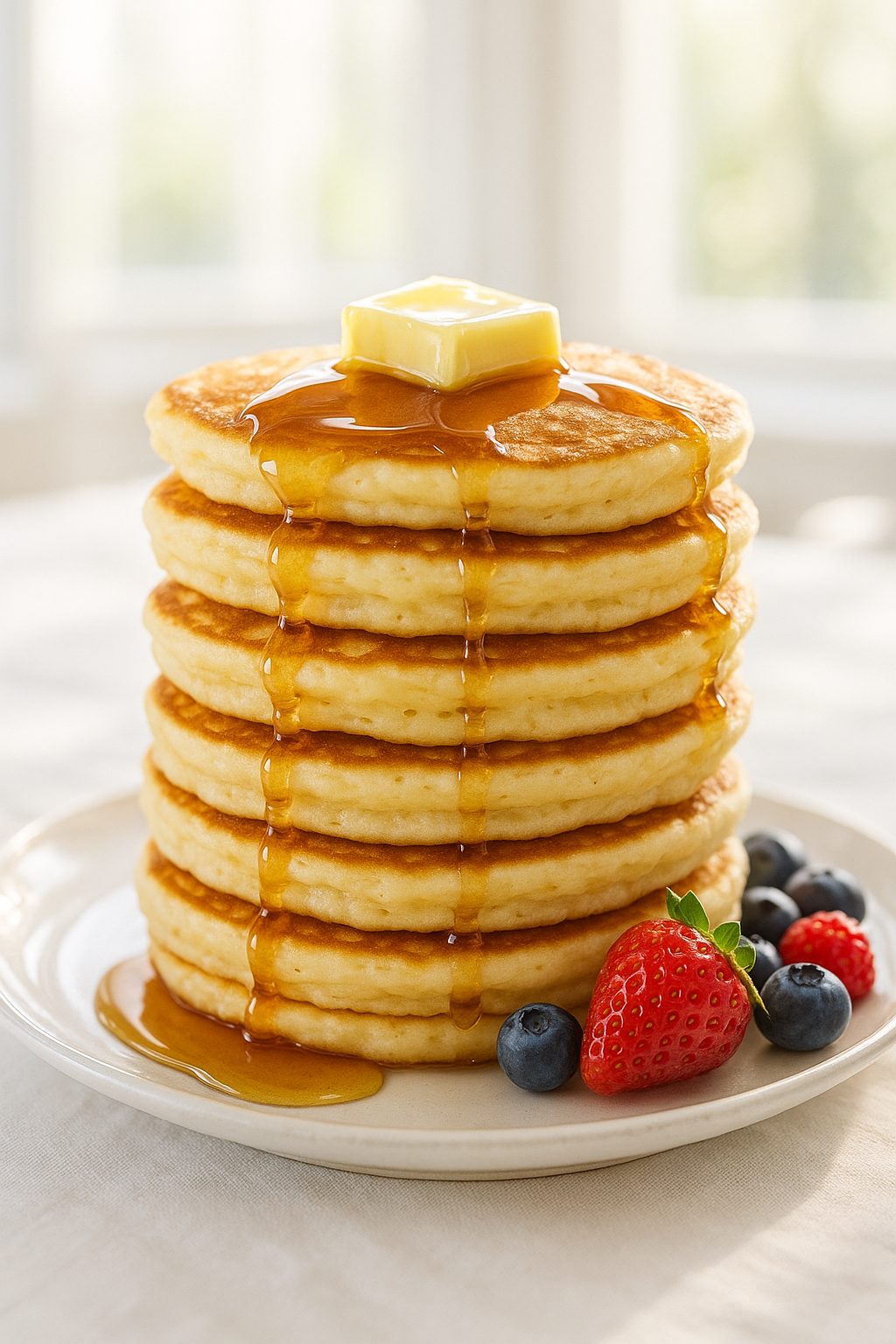
Fluffy Buttermilk Pancakes from Scratch
Ingredients
Method
- In a large bowl, whisk together the flour, sugar, baking powder, baking soda, and salt.
- In a separate bowl, whisk the buttermilk, eggs, melted butter, and vanilla until combined.
- Pour the wet ingredients into the dry and stir gently just until combined; the batter should still be lumpy. Let it rest for 5 minutes.
- Heat a lightly greased griddle or nonstick skillet over medium heat. Pour about 1/4 cup of batter per pancake.
- Cook until bubbles form on the surface and the edges look set, about 2 minutes, then flip and cook 1-2 minutes more until golden.
- Repeat with the remaining batter, keeping cooked pancakes warm in a low oven.