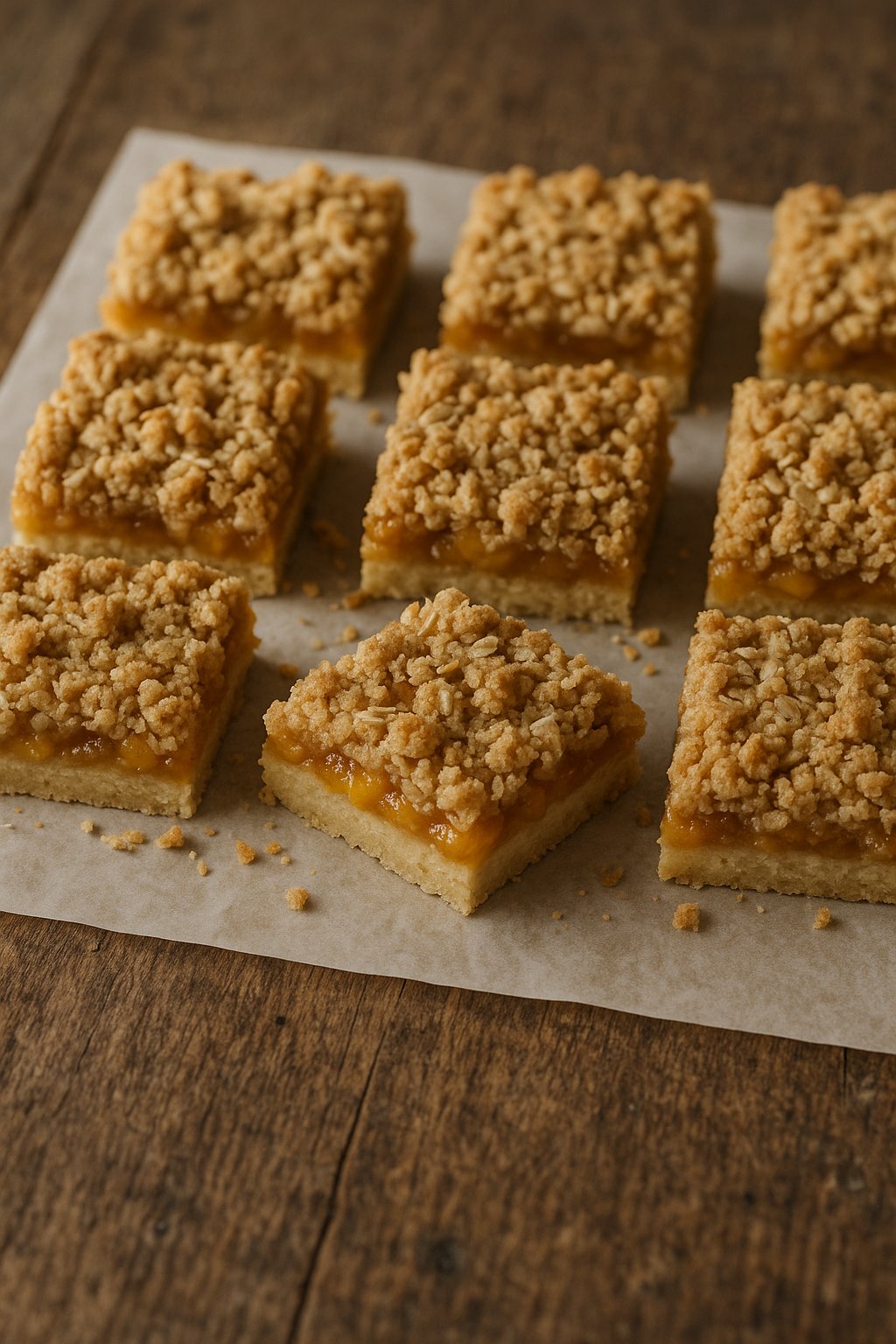
Juicy Peach Crumble Bars
These are what happens when you want peach pie but do not want to make pastry, and would also like to be able to eat it with one hand. One dough does double duty as both the base and the crumble on top, which means the entire recipe is one bowl and about twenty minutes of work.
Sixteen bars from a 9×13 pan. They travel well, they hold up on a picnic table, and they are the thing to make in August when peaches are cheap and briefly perfect.
Two Steps That Decide Whether These Work
Par-bake the base. Fifteen minutes in the oven before the fruit goes anywhere near it. Peaches release a great deal of liquid as they bake, and raw dough underneath will absorb it and turn to a wet, pale layer that never sets. Par-baking sets the surface of the crust so it stays distinct from the filling. Skipping this is the most common reason crumble bars come out soggy on the bottom.
Cool them completely. At least two hours, and this is not optional either. The cornstarch in the filling only finishes thickening as it cools — hot from the oven, the peach juice is still thin and mobile. Cut them warm and you get a delicious mess that has to be spooned. Cut them properly cool and you get bars with clean edges that hold their shape in a hand.
Two hours at room temperature works. An hour at room temperature followed by an hour in the fridge works faster and gives even cleaner cuts.
The Cornstarch Is Load-Bearing
Three tablespoons for five cups of fruit sounds like a lot. Peaches are roughly 88% water, and once heated they release most of it.
Cornstarch granules absorb that liquid and swell, thickening the juice into something that clings to the fruit instead of running. It needs to reach a proper temperature to activate, which is why the filling has to actually bubble at the edges before you take the pan out — a golden top over fruit that has not bubbled means the starch has not done its job yet.
Toss the cornstarch with the peaches and sugar until every slice is coated rather than dumping it in and stirring twice. Dry pockets of starch turn into unpleasant chalky lumps.
The lemon juice is doing quiet work alongside it — peaches are low in acid and taste flat when baked with sugar, and a tablespoon of lemon makes them taste distinctly more of peach.
Ingredient Notes
- Fresh peaches (5 cups, peeled and sliced). Ripe but still firm. Rock-hard peaches will not soften enough in 45 minutes and taste of nothing; overripe ones collapse into mush and release even more liquid. To peel them easily, score an X in the base, drop them into boiling water for 40 seconds, then into ice water — the skins slip straight off.
- Rolled oats (1 cup). Old-fashioned, not quick. Quick oats go pasty; rolled oats stay distinct and give the topping its texture.
- Melted butter (1 cup). A full cup, which makes this a rich dough that presses easily and clumps well for the topping. Melted rather than cut in cold, which makes the whole thing a stir-together job.
- Brown sugar (1 cup, packed). Packed firmly into the cup. It brings moisture and a caramel note that white sugar does not.
- Parchment with overhang. Genuinely necessary. These bars are sticky and dense, and lifting the whole slab out to cut on a board is the only way to get clean pieces. Cutting in the pan tears them.
Method
Heat the oven to 350°F and line the 9×13 with parchment, leaving overhang on two sides.
Make the dough: whisk the flour, oats, brown sugar, baking powder, salt, and cinnamon, then pour in the melted butter and vanilla and stir until crumbly and evenly moistened. It should hold together when squeezed.
Press two-thirds firmly into the pan and bake 15 minutes. Firmly and evenly — use the flat bottom of a measuring cup. A loosely pressed base crumbles apart later.
Toss the peaches with the granulated sugar, cornstarch, and lemon juice while the base bakes, coating every slice.
Spread the fruit over the hot base in an even layer.
Squeeze the remaining third of the dough into clumps and scatter over the fruit, leaving gaps. The gaps matter — they let steam escape and let the filling bubble up and caramelize. A solid sealed lid of topping traps moisture and goes soft.
Bake 40–45 minutes until the topping is deep golden and the filling is visibly bubbling at the edges.
Cool completely in the pan, at least 2 hours, then lift out and cut into 16 bars.
Troubleshooting
- Soggy bottom. The base was not par-baked, or the peaches were very ripe and juicy.
- Runny filling. Cut before cooling, or the filling never actually bubbled in the oven.
- Bars fall apart. Base not pressed firmly enough, or cut while warm.
- Topping pale and soft. Spread too evenly with no gaps, or under-baked.
- Chalky spots. Cornstarch not tossed through the fruit thoroughly.
- Dry and crumbly overall. Too much flour, from scooping rather than spooning it into the cup.
Variations
- Other fruit. Apples, plums, nectarines, or mixed berries all work with the same quantities. Berries release more liquid, so use an extra tablespoon of cornstarch.
- Peach and raspberry. Replace a cup of the peaches with raspberries. The tartness is excellent against the sweet crust.
- Add nuts. 1/2 cup of chopped pecans or almonds in the topping portion of the dough.
- Ginger. 1/2 teaspoon of ground ginger in the dough, or a tablespoon of finely chopped crystallized ginger in the fruit.
- Glaze. Whisk 1/2 cup powdered sugar with a tablespoon of milk and drizzle over the cooled bars.
- Smaller batch. Halve everything into an 8×8 pan; reduce the second bake to about 35 minutes.
- Frozen or canned peaches. Frozen work without thawing — add 5 minutes and an extra tablespoon of cornstarch. Canned peaches should be drained very well and patted dry.
Storage and Freezing
Store in an airtight container at room temperature for 3 days, or refrigerated for up to 5. They firm up in the fridge and the topping softens slightly; ten minutes on the counter brings them back.
Layer them with parchment between the layers so they do not stick to each other.
They freeze well for up to 3 months. Cool completely, cut into bars, and freeze on a tray before bagging so they do not fuse. They thaw at room temperature in about half an hour, and a frozen bar warmed for 15 seconds in the microwave is very good.
You can also freeze the dough alone. It keeps 3 months and means these are only as much work as slicing peaches.
How to Serve Them
On their own, out of hand, with coffee. Warm with a scoop of vanilla ice cream, which turns them into a proper dessert. A dollop of lightly whipped cream. They are sturdy enough for lunchboxes and picnics, which is most of the reason to make bars rather than a crumble in a dish.
Questions
Do I have to peel the peaches?
It gives a better texture — the skins separate and become chewy strips in the filling. The boiling water trick makes it quick.
Can I use canned or frozen peaches?
Yes. Drain canned peaches very well; use frozen straight from the freezer with an extra tablespoon of cornstarch and 5 extra minutes.
Why are my bars runny?
Cut too soon, or the filling never reached a bubble in the oven. Both are needed for the cornstarch to set.
How long do they need to cool?
Two hours minimum. Chilling for the last hour makes cutting easier.
Can I make them the day before?
Yes, and they are arguably better on day two once everything has settled. Keep them covered at room temperature.
Can I use quick oats?
They will work but the topping will be softer and more uniform. Rolled oats give a much better crumble.
What size pan do I need?
9×13. In a smaller pan the layers are too thick and the middle will not bake through properly.
Juicy Peach Crumble Bars
Ingredients
Method
- Heat the oven to 350°F. Line a 9x13-inch pan with parchment, leaving overhang on two sides.
- In a large bowl, whisk together the flour, oats, brown sugar, baking powder, salt, and cinnamon. Pour in the melted butter and vanilla and stir until crumbly and evenly moistened.
- Press about two-thirds of the mixture firmly and evenly into the bottom of the pan. Bake for 15 minutes, until just set at the edges.
- Meanwhile, toss the sliced peaches with the granulated sugar, cornstarch, and lemon juice until every slice is coated.
- Spread the peaches evenly over the hot par-baked crust. Squeeze the remaining dough into clumps and scatter them over the fruit, leaving some gaps so the filling can bubble through.
- Bake 40 to 45 minutes more, until the topping is deep golden and the filling bubbles at the edges. Cool completely in the pan, at least 2 hours, before lifting out and slicing into 16 bars.