The Best Fudgy Chocolate Brownies
I spent a long time being disappointed by homemade brownies. Mine always came out somewhere between a dry chocolate cake and a pan of chocolate-flavored bread — fine, technically, but never the dense, glossy-topped, slightly-underdone-in-the-middle brownie I actually wanted. The box mix beat me every single time, which was humbling.
What finally fixed it wasn’t a fancier chocolate or a longer ingredient list. It was the opposite: less flour, more sugar, no leavening at all, and a full two minutes of whisking before the dry ingredients ever go in. This recipe uses cocoa powder rather than melted bar chocolate, so there is no double boiler and no chopping — one bowl, a whisk, and about fifteen minutes of actual work.
These are the brownies I make when someone is coming over and I have forgotten they were coming over.
Why These Brownies Turn Out Fudgy Instead of Cakey
The difference between a fudgy brownie and a cakey one is almost entirely structure — specifically, how much of it you build. Three things in this recipe deliberately keep that structure low:
There is very little flour. Half a cup for a full 8×8 pan is a fraction of what a cake would use. Flour provides gluten, gluten provides chew and lift, and lift is exactly what we do not want here. Less flour means the brownie sets into something dense that holds together by fat and sugar rather than by crumb.
There is no baking powder or baking soda. Most cakey brownie recipes include one. Leavening pushes air through the batter as it bakes and produces that open, spongy interior. Leaving it out entirely is the single biggest lever you have.
The fat is melted butter, not creamed butter. Creaming softened butter with sugar whips air into the mixture, which again pushes things toward cake. Melted butter coats the flour instead, restricting gluten development and giving you that characteristically moist, close-grained middle.
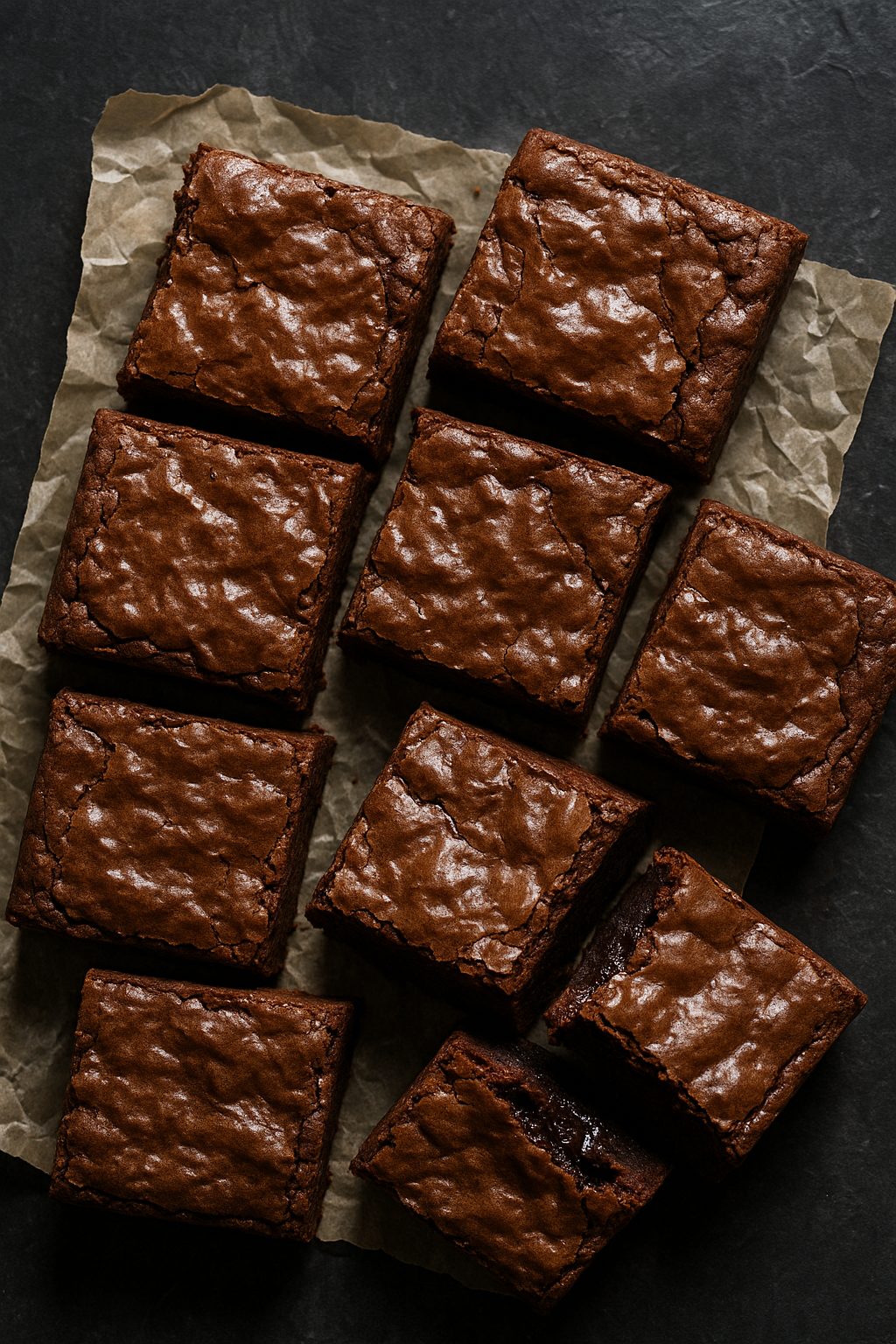
The whisking step earns its own mention. Beating the eggs and sugar hard for a full minute dissolves the sugar and suspends it in the egg, and that dissolved sugar is what rises to the surface during baking and dries into the thin, papery, crackly top. Skip the whisking and the brownies still taste good, but the top comes out dull and matte. It is genuinely the difference between a brownie that looks homemade in a good way and one that looks homemade in the other way.
Ingredient Notes
- Butter (1/2 cup, melted). Melt it and then let it sit for a minute or two before adding the eggs. Butter straight off the heat can be hot enough to start cooking the eggs, which leaves you with tiny scrambled flecks in the batter. Warm is what you want, not hot. Salted butter is fine — if you use it, cut the added salt to a pinch.
- Granulated sugar (1 cup). This looks like a lot for one small pan and it is supposed to. Sugar here is not only sweetness; it is moisture retention and it is the crackly top. Reducing it meaningfully changes the texture, not just the flavor. If you want a less sweet brownie, use a darker, more bitter cocoa instead of cutting the sugar.
- Eggs (2 large). Room temperature eggs incorporate faster and hold more air during the whisking step. If yours are cold, sit them in a bowl of warm tap water for five minutes.
- All-purpose flour (1/2 cup). Measure it by spooning it into the cup and leveling it off. Scooping the cup directly through the flour bag compacts it and can add 20–25% more flour than intended, which is the most common reason a fudgy brownie recipe bakes up cakey for someone.
- Unsweetened cocoa powder (1/3 cup). Natural or Dutch-process both work here because there is no baking soda that needs an acid to react with. Dutch-process gives a darker color and a smoother, less fruity chocolate flavor; natural cocoa is sharper and more classic. Sift it — cocoa clumps are stubborn and will not whisk out.
- Salt (1/4 teaspoon). Non-negotiable. Chocolate without salt tastes flat and vaguely dusty.
- Chocolate chips (1/2 cup). These melt into pockets rather than dispersing, so you get bites of actual molten chocolate against the cocoa base. Chopped chocolate from a bar works even better if you have it, since the irregular pieces create both fine streaks and big pools.
How to Make Them
1. Prep the pan properly. Line an 8×8-inch pan with parchment, leaving overhang on two sides. This is not fussiness — fudgy brownies are sticky and dense, and lifting the whole slab out by the parchment is the only reliable way to get clean edges. Cutting them in the pan tears them.
2. Whisk the melted butter and sugar for about a minute, until the mixture looks glossy and slightly grainy rather than separated and oily. It will not become smooth like a frosting; sugar does not fully dissolve in fat alone. Glossy is the cue.
3. Add the eggs and vanilla and whisk vigorously for another full minute. This is the step people rush. The batter should visibly lighten in color, from dark amber to a paler tan, and thicken enough that the whisk leaves a trail that takes a second to disappear. Sixty seconds by the clock is longer than it feels.
4. Sift in the flour, cocoa, and salt and fold gently with a spatula, not the whisk. Stop the moment the last streak of dry disappears. Every extra stroke past that point develops gluten and moves you toward cake. A few faint marbled patches are better than an over-mixed batter.
5. Fold in the chocolate chips and spread the batter into the pan. It will be thick and reluctant, closer to a stiff frosting than a pourable batter — that is correct. Push it into the corners with an offset spatula or the back of a spoon.
6. Bake 22–25 minutes at 350°F. Pull them when the top is set and matte across the whole surface and a toothpick inserted about an inch from the edge comes out with moist crumbs clinging to it. If it comes out clean, they are already slightly overbaked. The center will still look underdone and will firm up as it cools.
7. Cool completely before slicing. I know. But a warm fudgy brownie has not set yet, and cutting into it gives you a delicious smear rather than a square. At least an hour at room temperature, or 30 minutes in the fridge if you are impatient.
The Mistakes That Ruin Them
- Overbaking. By far the most common. The margin between fudgy and dry is about three minutes. Check at 22 and trust the moist-crumb toothpick, not the clock.
- Over-mixing after the flour goes in. Fold, do not beat, and stop early.
- Packing the flour. Spoon and level. This one silently sabotages more brownies than anything else.
- Cutting them warm. Patience is an ingredient.
- Using a glass pan without adjusting. Glass holds heat longer and the edges will overbake. If glass is what you have, drop the oven to 325°F and start checking at 25 minutes.
Variations
- Salted brown butter. Cook the butter until the milk solids turn golden and smell nutty, then cool it slightly before using. Finish with flaky salt on top before baking. This is the version I make most often now.
- Espresso. Whisk 1 teaspoon of instant espresso powder in with the cocoa. It does not taste like coffee; it makes the chocolate taste more like chocolate.
- Peanut butter swirl. Dollop 1/3 cup of warmed peanut butter over the batter and drag a knife through it in an S shape. Do not over-swirl or you lose the contrast.
- Thicker brownies. Bake in a loaf pan instead and add 8–10 minutes. You get fewer, taller squares with a higher ratio of gooey middle to edge.
- Doubled for a crowd. Double everything into a 9×13 pan and bake 28–32 minutes. Do not simply double the time.
Storage and Make-Ahead
Store the brownies in an airtight container at room temperature for up to 4 days. Do not refrigerate them for storage — the fridge dries them out and mutes the chocolate flavor, and they go noticeably firm. If you have already refrigerated them, let the squares sit out for 20 minutes before eating and most of the texture comes back.
They freeze very well for up to 3 months. Cool completely, cut into squares, and freeze them on a tray for an hour before transferring to a bag — freezing them loose first keeps them from fusing into one block. They thaw at room temperature in about 30 minutes, and a frozen brownie eaten straight from the freezer is its own excellent thing.
The batter itself does not hold well, so if you are making these ahead, bake them and freeze rather than refrigerating unbaked batter.
What to Serve With Them
Warm, with vanilla ice cream and a spoonful of the melted chocolate that pools underneath. Cold, with coffee, standing at the counter. Cut small and stacked on a plate they work for a party; cut into four enormous slabs they work for a bad week. For a plated dessert, a spoonful of lightly whipped unsweetened cream cuts the sweetness better than more chocolate does.
Frequently Asked Questions
Why did my brownies come out cakey?
Almost always too much flour (from scooping rather than spooning), over-mixing after the flour went in, or an accidental addition of baking powder. This recipe has no leavening on purpose.
Why is my top not shiny and crackly?
The sugar was not dissolved enough. Whisk the sugar with the melted butter, then whisk hard for a full minute after adding the eggs. That dissolved sugar is what forms the crackly layer.
Can I use melted chocolate instead of cocoa powder?
Not as a direct swap — melted chocolate brings its own sugar and cocoa butter, and substituting it one-for-one will make the batter loose and overly sweet. Cocoa powder is what keeps this a one-bowl recipe.
Can I make these gluten-free?
Yes, and they are one of the better candidates for it, since there is so little flour to begin with. A cup-for-cup gluten-free blend works with no other changes.
How do I get perfectly clean edges?
Chill the cooled slab for 30 minutes, lift it out by the parchment, and cut with a large knife wiped clean between every single cut. Wiping the blade is the part that actually matters.
Can I halve the recipe?
Halve everything and bake in a loaf pan for 18–20 minutes. One egg instead of two is a slightly awkward split, so if you want to be precise, whisk one egg and use about 25 grams of it.
The Best Fudgy Chocolate Brownies
Ingredients
Method
- Preheat the oven to 350°F (175°C) and line an 8x8-inch pan with parchment paper.
- In a large bowl, whisk the melted butter and sugar together for about a minute, until glossy.
- Add the eggs and vanilla and whisk vigorously for another minute until smooth and lighter in color.
- Sift in the flour, cocoa powder, and salt, and fold gently until just combined.
- Fold in the chocolate chips, then spread the batter into the prepared pan.
- Bake for 22-25 minutes, until the top is set and a toothpick comes out with a few moist crumbs. Cool before slicing.