Bakery-Style Banana Chocolate Chip Muffins
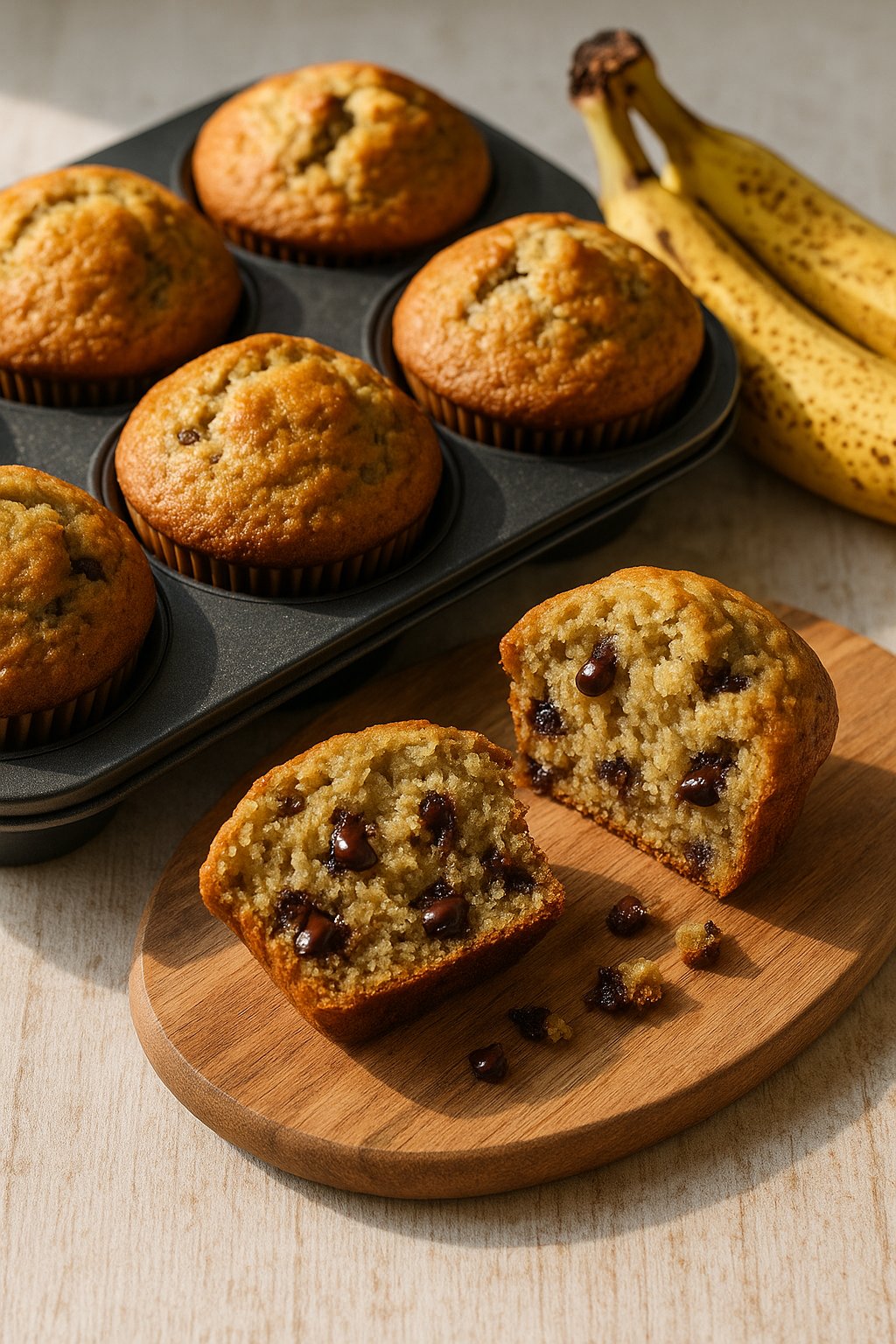
Bakery muffins have a particular shape: a tall, cracked, mushroom-shaped dome that spills over the edge of the paper. Home muffins usually come out flat on top, or gently rounded at best. For a long time I assumed that was down to some commercial equipment I did not have.
It is not. It is oven temperature, and it costs nothing to fix.
The Temperature Trick That Makes the Dome
These start at 425°F for five minutes, then drop to 350°F for the rest of the bake without opening the door.
Here is what that does. Muffin batter contains baking soda that starts producing carbon dioxide as soon as it hits liquid, and water that turns to steam in the oven. That initial blast of high heat causes a violent burst of expansion — the gases push upward hard while the outside of the muffin is still soft and unset, so the batter climbs rather than spreading. That is the dome.
Then the temperature drops, which lets the inside cook through gently without the outside burning. If you baked the whole thing at 425°F you would get a spectacular dome and a raw centre; at a steady 350°F you get an evenly cooked, flat-topped muffin.
Two rules make it work. Do not open the oven during the transition — just turn the dial down. And fill the cups nearly to the top rather than the usual two-thirds. There has to be enough batter for the dome to be made of.
Mix It Badly, On Purpose
The other rule, and it is the one people break: stop stirring while the batter still looks lumpy.
Once flour meets liquid, gluten starts to form, and gluten is what gives bread its chew. In a muffin it produces something tough and rubbery, riddled with long tunnels, with a peaked pointy top instead of a rounded dome. Muffin batter should be stirred with a spatula, about ten to twelve strokes, and stopped the moment the last streak of dry flour disappears.
The lumps are fine. They hydrate during the bake. A perfectly smooth muffin batter is an over-mixed one.
This is also why the dry ingredients go straight on top of the wet in one bowl rather than being whisked separately. Fewer transfers, fewer strokes, less gluten.
Ingredient Notes
- Very ripe bananas (3, about 1 1/4 cups mashed). Heavily spotted or black. As a banana ripens its starches convert to sugar, so a spotted banana is dramatically sweeter and more aromatic than a yellow one. Under-ripe bananas are the main reason homemade banana muffins taste bland. If yours are not there, bake them in their skins at 350°F for 15 minutes until black.
- Melted butter (1/2 cup). Melted rather than creamed. Creaming beats in air that makes muffins cakey; melted butter coats the flour and gives a denser, moister crumb.
- Sour cream (1/4 cup). A small amount doing a lot. It is acidic, which activates the baking soda and tenderizes gluten, and its fat keeps the muffins moist for days. Greek yogurt works identically.
- Brown sugar (3/4 cup). Molasses adds moisture and a caramel note. Packed firmly into the cup.
- Flour (2 cups, spooned and leveled). Spoon it in and level it off. Scooping the cup through the bag compacts the flour and can add a quarter more than intended — the classic cause of dry, heavy muffins.
- Chocolate chips (1 1/4 cups). Plus extra scattered on top before baking, which is purely cosmetic and completely worth it.
Method
Heat the oven to 425°F and line a 12-cup tin.
Mash the bananas until mostly smooth, then whisk in the melted butter, brown sugar, eggs, sour cream, and vanilla. Everything up to this point can be mixed freely.
Add the flour, baking soda, salt, and cinnamon directly on top and stir just until the flour disappears. Spatula, a dozen strokes, lumps welcome.
Fold in the chocolate chips with a few strokes. Tossing them in a teaspoon of the flour first stops them all sinking, if that bothers you.
Divide among the cups, filling nearly to the top, and scatter a few extra chips over each.
Bake 5 minutes at 425°F, then reduce to 350°F without opening the door and bake 13–15 minutes more, until a toothpick comes out with moist crumbs. Not clean — clean means slightly overbaked.
Cool in the pan 5 minutes, then move to a rack. Leaving them in the tin longer steams the bottoms soft.
Troubleshooting
- Flat tops. Cups not filled enough, or the oven was not started hot. Fill nearly to the top and use the temperature drop.
- Tough with tunnels, pointed tops. Over-mixed.
- Dry. Too much flour, or overbaked. Spoon and level, and start checking at 13 minutes.
- Not much banana flavour. Bananas were not ripe enough.
- Chips all sank. Toss them in flour first, and keep some for the top.
- Stuck to the pan. Grease the top surface of the tin as well as the cups — the domes spread onto it.
Variations
- Walnut. 3/4 cup toasted chopped walnuts, in place of or alongside some of the chips.
- Streusel top. Rub 1/4 cup flour, 1/4 cup brown sugar, and 2 tablespoons cold butter into crumbs and scatter over before baking.
- Peanut butter. Swirl a teaspoon of warmed peanut butter into each cup before baking.
- Mini muffins. Same method, 5 minutes at 425°F then about 7 minutes at 350°F. Makes about 30.
- Loaf. The same batter bakes as a 9×5 loaf at a steady 350°F for 55–65 minutes.
- Less sweet. Drop the brown sugar to 1/2 cup. With black bananas you will barely notice.
- Dairy-free. Coconut oil for the butter and a dairy-free yogurt for the sour cream.
Storage and Freezing
Store in an airtight container at room temperature for 3 days. Put a paper towel in the bottom and another on top — muffins release moisture as they sit, and that moisture collects on the tops and makes them sticky. The towels absorb it.
Do not refrigerate. It dries baked goods out faster than the counter does.
They freeze very well for up to 3 months. Cool completely, then freeze in a bag. Thaw at room temperature for about half an hour, or microwave a frozen one for 30 seconds — that brings back the just-baked softness and re-melts the chocolate chips, which is arguably better than fresh.
The batter does not keep. The baking soda begins reacting immediately and batter left overnight produces flat muffins. If you want to get ahead, mash the bananas and freeze them, or whisk the dry ingredients together in advance.
Questions
How ripe should the bananas be?
Heavily spotted at minimum; black is better. This is the biggest single factor in how these taste.
Why did my muffins come out flat?
Cups were underfilled, or the oven did not start at 425°F. Both are needed for the dome.
Can I make the batter the night before?
No — the leavening will be spent. Freeze mashed bananas or pre-mix the dry ingredients instead.
Can I use frozen bananas?
Yes, and they are excellent. Thaw fully and include all the liquid that comes out.
Do I have to use sour cream?
Greek yogurt substitutes directly. Leaving it out entirely makes drier, less tender muffins.
How do I stop the chocolate chips sinking?
Toss them in a teaspoon of the measured flour before folding them in, and reserve some to scatter on top.
Can I double the recipe?
Yes, but bake one tray at a time in the centre of the oven. Two trays at once disrupts the temperature blast that creates the dome.
Bakery-Style Banana Chocolate Chip Muffins
Ingredients
Method
- Heat the oven to 425°F. Line a 12-cup muffin tin with paper liners or grease it well.
- Mash the bananas in a large bowl until mostly smooth. Whisk in the melted butter, brown sugar, eggs, sour cream, and vanilla until combined.
- Add the flour, baking soda, salt, and cinnamon directly on top. Stir with a spatula just until the flour disappears — a few lumps are fine. Do not overmix.
- Fold in the chocolate chips with just a few strokes.
- Divide the batter among the 12 cups, filling each nearly to the top. Scatter a few extra chocolate chips over each.
- Bake at 425°F for 5 minutes, then — without opening the oven — reduce the temperature to 350°F and bake 13 to 15 minutes more, until a toothpick comes out with moist crumbs. Cool in the pan 5 minutes, then transfer to a rack.